


Tanah Merah
Art Resort
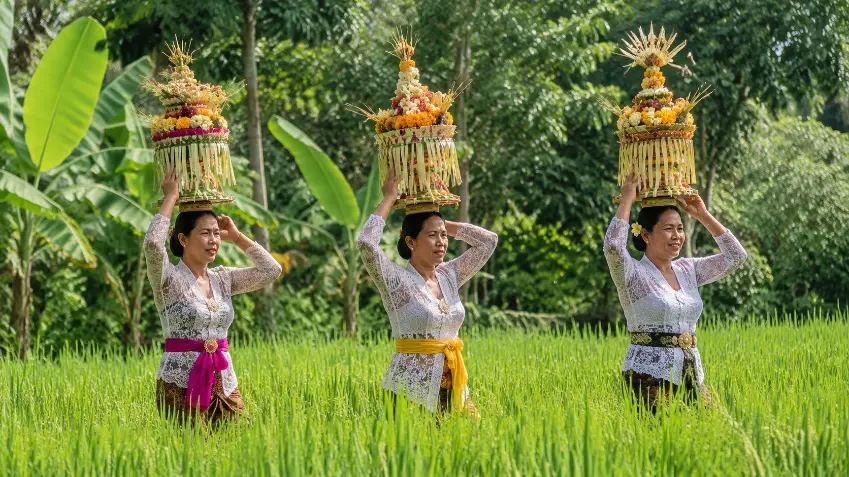
Canang sari are small daily offerings made by Balinese Hindus as an expression of gratitude and prayer to Sang Hyang Widhi Wasa. You will often see them at house entrances, family shrines, shop counters, and along pavements. They are part of an active religious practice, not decorations or rubbish, so the simplest visitor rule is to leave them undisturbed and walk around them.
A canang sari is a small offering, usually arranged in a tray woven from young coconut leaves. The word canang refers to the tray, while sari is commonly translated as "essence". The offering is presented with prayer, often accompanied by incense and holy water, as a daily act of devotion.
The practice is connected to yadnya, the idea of a sincere offering, and is often understood alongside Tri Hita Karana. This Balinese Hindu philosophy describes well-being through harmony between people and the divine, between people, and with the natural world. A canang sari may look simple, but it brings these relationships into an everyday household or working routine.
The base is folded from young coconut leaves and may be square, round, or shaped differently according to local practice. Flowers are arranged on top, sometimes with pandan leaves, rice, fruit, or other small items. Beneath the flowers, a small element called porosan is often placed. It commonly contains betel leaf, areca nut, and lime, and carries its own religious symbolism.
You may notice flowers arranged by colour and direction. Some traditions associate particular colours with deities and compass points, but the details can vary between offerings and local explanations. Because the materials are natural and locally available, two offerings may look different while serving a similar devotional role.
First, canang sari is not a general name for every Balinese offering. Banten is a broader term for ritual offerings, while canang sari is one familiar daily form. You may also see segehan, a distinct offering associated with bhuta kala, a category of forces in Balinese Hindu cosmology. This is why it is inaccurate to treat every ground-level offering as the same object or assume that all offerings serve one purpose. Their placement is meaningful, so leave them where they are.
Second, the offering is not simply a pretty basket of flowers. The time spent preparing it, the prayer, and the act of presenting it are central to its meaning. Many households prepare offerings daily, while others buy ready-made canang from local sellers. The method may change with modern schedules, but buying an offering does not automatically make the act less sincere.
Third, an offering does not remain fresh forever. After it has been presented, flowers may wilt, incense burns out, and birds or insects may take the food. This does not mean visitors should clear it away. The household or people responsible for the space will decide when to remove it.
A few small habits will help you move around Bali respectfully. These simple actions matter most at busy entrances, narrow village lanes, and temple surroundings. If you are unsure whether a space is open to visitors, ask your host or guide rather than guessing.
Understanding canang sari changes how you read everyday life in Bali. A small tray at a doorway can reflect gratitude, devotion, family routine, and a relationship with the surrounding world. The most respectful response is not to treat it as a photo prop, but to notice it without interrupting the people who make and present it.
Tanah Merah Art Resort is located in Melayang, Ubud, and offers a village experience led by local guides. The walk introduces guests to daily activities, religious events, and family life through local context. If you would like to understand more about the community around the resort, read about the Melayang Village experience and follow your guide's advice when observing local customs.
