


Tanah Merah
Art Resort
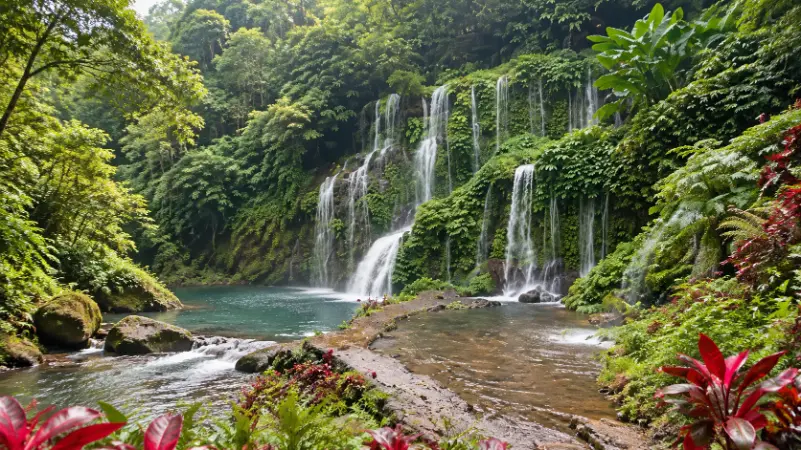
The Petanu River is one of the defining natural features of Tanah Merah Art Resort in Ubud, Bali. Set above a forested river gorge, the resort offers views of tropical greenery and access to a natural waterfall, a sacred Beji site, and holy springs. However, reaching the river is not the same as walking to a conventional hotel swimming pool. The route involves steps down into the valley, river conditions can change after heavy rain, and visitors should understand the local cultural significance before swimming, taking photographs, or approaching the springs.
The Petanu River provides more than an attractive background for photographs. Its deep gorge, surrounding rainforest, flowing water, and natural waterfall contribute to the sense of seclusion that distinguishes Tanah Merah from accommodation in busier parts of Ubud. According to the resort's official Petanu River page, guests have direct access to the river floor, where the natural surroundings include a sacred Beji site and holy springs. These features connect the resort experience with both the landscape and the cultural traditions associated with water in Bali.
The river also shapes the way visitors experience the property from above. Forested slopes and the sound of flowing water create a natural setting for relaxing, enjoying the views, and spending time away from busy streets. You do not necessarily need to enter the river to appreciate this environment. For many guests, the scenery from the resort grounds can be a rewarding experience in itself.
Visitors should expect the route to be more demanding than a short, level garden walk. The resort has described a staircase leading down to the Petanu River, while guest reviews characterize the route as steep and physically challenging on the return journey. One older visitor review counted approximately 105 steps, but this is not a current official measurement of the route. The exact condition of the stairs, accessibility, and any changes to the pathway should be confirmed with the resort before visiting.
The descent may be manageable for visitors who are comfortable with uneven terrain and stairs, but the climb back up requires additional effort. Wet steps, humidity, slippery surfaces, and fatigue can make the journey more difficult, particularly after swimming. Visitors with limited mobility, knee problems, balance difficulties, or cardiovascular concerns should discuss the route with resort staff before deciding to go down.
Wear footwear with good grip and avoid rushing, especially if the steps are damp. Keep your hands free where possible so you can use available handrails, and do not attempt the descent if staff advise against it. If your main interest is the view rather than swimming, ask whether there is an accessible viewpoint within the resort that offers a suitable alternative.
Natural rivers require different precautions from controlled swimming pools. Water depth, current strength, submerged rocks, and footing can vary along a river, even when the surface initially looks calm. The resort's published river-tour description has warned that swimming against the current can become challenging, especially after heavy rain. Visitors should therefore confirm the current conditions and whether any guided river activity is operating before entering the water.
If the resort permits access, follow the staff's instructions about where to enter, which areas to avoid, and whether swimming is appropriate that day. Never enter a section that has been closed or ignore advice from a guide who knows the local conditions. Avoid jumping from rocks, swimming near fast-moving water, or attempting to reach a waterfall through an unfamiliar route. Do not assume that a shallow-looking section is safe, since submerged rocks and sudden changes in depth may not be visible.
It is also important to understand what supervision is actually provided. The resort's earlier river-tour description referred to guides accompanying the experience, but the current availability and arrangements for that activity should be confirmed directly. Ask whether a guide will accompany your visit, what safety equipment is available, and whether there are restrictions based on water conditions. Do not treat the presence of a guide as a guarantee that every part of the river is safe.
Rain does not automatically mean every part of the resort must close, but it can make river access substantially more dangerous. Heavy rainfall can increase water levels, strengthen currents, reduce visibility, and make the staircase and riverbank slippery. The Indonesian Meteorology, Climatology, and Geophysics Agency provides official weather warnings, while its safety information explains that heavy or prolonged rainfall upstream can contribute to flash flooding even when conditions downstream appear relatively clear.
For that reason, do not decide whether to swim based only on the weather directly above the resort. If rain is heavy, thunder is nearby, the water is rising, or the current appears unusually fast or muddy, postpone the river visit and follow the resort's instructions. The same caution applies after heavy rainfall, even if the rain has already stopped. Ask staff when conditions have been assessed as suitable again rather than assuming the river will immediately return to normal.
You can still enjoy the surrounding landscape during wet weather if the resort confirms that the relevant areas are open and accessible. Viewing the river from a safe position may be a better choice than descending a wet staircase or entering the water. Flexibility is especially valuable when planning outdoor activities in Bali, where local rainfall can differ from the forecast for a wider area.
There is no verified current statement from the resort confirming that swimming in the Petanu River is suitable for all children or non-swimmers. A natural river with variable currents and potentially uneven footing should not be treated as a family swimming area without specific guidance. Parents and guardians should ask the resort about minimum age recommendations, supervision requirements, permitted areas, and the availability of appropriate flotation equipment before considering water activities.
Children should remain under close adult supervision near the river, staircase, and riverbank. If staff cannot confirm that conditions and the proposed activity are suitable, do not take children into the water. Non-swimmers should not attempt to cross the river, follow a current, or join an upstream swimming route. Even confident swimmers should avoid entering the water alone or venturing beyond an area approved by the resort.
If your family wants to enjoy the tropical setting without the uncertainty of a natural river, ask about the resort's separate swimming pools. The Petanu Swimming Pool is described as a shaded pool surrounded by greenery near the Shala. It offers a different way to enjoy the river landscape, although you should still confirm the pool's depth, supervision arrangements, and suitability for young children.
One important detail distinguishes the Petanu River from an ordinary recreational swimming spot. Tanah Merah's official information identifies a sacred Beji site and holy springs within its river setting. In Bali, water can have cultural and religious significance beyond its practical uses, and some springs or bathing areas may be associated with purification practices or local community traditions. Visitors should approach these places with respect rather than assuming that every accessible section is available for unrestricted swimming.
The resort's earlier river-tour description also referred to offerings made before entering the water and described a natural spring used by villagers from Melayang to collect drinking water. Because that description is not currently accessible at its former URL, the present arrangements and any restrictions should be verified directly with the resort. In particular, ask staff to identify any Beji area, spring, or section of the river where swimming, bathing, or entry is not permitted. Do not enter a restricted area simply because there is no obvious physical barrier.
There is insufficient publicly verified information to identify every section of the Petanu River along the resort's property as either sacred or unrestricted. The safest approach is to follow posted signs and staff guidance, stay outside areas reserved for local religious or community activities, and avoid disturbing offerings or other sacred objects. If a ceremony is taking place, give participants space and do not enter the area unless you have been explicitly invited to do so.
No specific current dress code for swimming in the Petanu River at Tanah Merah was found in the accessible official information. It would therefore be inaccurate to claim that ordinary swimwear is either universally permitted or prohibited throughout the river area. Visitors should distinguish between a recreational swimming area and a sacred spring or Beji site, since the expectations for appropriate clothing and behaviour may differ.
For ordinary swimming, ask the resort whether standard swimwear is acceptable in the designated area. When approaching a sacred spring or a place associated with local rituals, choose modest clothing and follow the instructions given by staff or local representatives. Bali's official tourist conduct guidance emphasizes respect for sacred places, religious objects, local customs, and appropriate dress. Bringing a light cover-up or sarong is a practical precaution if you plan to move between swimming and culturally significant areas.
Comfort and safety matter as well as cultural sensitivity. Wear footwear with traction for the staircase and riverbank, and avoid clothing or accessories that could catch on rocks or branches. If the resort identifies a particular dress requirement for a sacred area, follow that requirement rather than relying on general advice about swimwear.
The Petanu River gorge and waterfall can provide memorable photographs of Bali's natural landscape. However, photography should not take priority over personal safety or respect for local traditions. Take pictures only from safe, permitted locations, and avoid standing on unstable rocks or approaching the water's edge for a better angle. Keep your equipment secure when descending the stairs, and do not attempt to take photographs while navigating a slippery section of the route.
The resort identifies the Beji site and holy springs as culturally significant, but the publicly available information does not establish a complete photography policy for these locations. Before photographing a spring, offering, ceremony, or person participating in a religious activity, ask whether photography is permitted. If staff or community members indicate that photographs are not appropriate, respect that instruction without argument.
Visitors should also avoid leaving rubbish, touching offerings, or disturbing the natural surroundings. The Indonesian government and Bali's official tourist conduct guidance emphasize respecting sacred places and local wisdom, behaving appropriately, and keeping natural environments clean. These simple practices help preserve the experience for other visitors and the local community.
Choosing between the river and a resort pool depends on what you want from your stay. The river offers a closer connection with the landscape, including natural water, forest vegetation, and a waterfall, but access requires more care and conditions can change. The resort's Petanu Swimming Pool provides a separate swimming option surrounded by tropical greenery, making it worth considering if you prefer to relax without descending to the river floor.
Neither option should be assumed to have safety arrangements that have not been confirmed. Ask the resort about pool depth, lifeguard availability, children's supervision, and any temporary closures before deciding which facility best suits your group. If the river is unsuitable because of rain, strong currents, or a restricted access route, a pool visit or a safe viewpoint may offer a more appropriate alternative.
Before heading down to the Petanu River, contact Tanah Merah Art Resort to confirm whether access is currently open and whether a guided river experience is available. Ask about the condition of the staircase, recent rainfall, current strength, water depth, permitted swimming areas, and any restrictions around the Beji site and holy springs. If you are travelling with children, non-swimmers, or anyone with limited mobility, explain your circumstances so staff can advise whether the route and activity are appropriate.
The resort's Petanu River information page is a useful starting point for understanding the natural and cultural features of the property. You can also review the resort facilities to compare other ways to enjoy the surroundings before making plans. By checking the details in advance, you can decide whether a river visit suits your comfort level, physical ability, and interests.
The Petanu River is best appreciated with a combination of curiosity, preparation, and respect. Its scenery is a distinctive part of the Tanah Merah experience, but the steep access route, changing river conditions, and sacred springs deserve careful consideration. Whether you choose to view the gorge, enjoy the resort pool, or join a permitted guided experience, let current safety advice and local customs guide your decision.
